Watts per kg calculator
Watts per kilogram (W/kg) is your power divided by your body weight: 250 W at 75 kg is 3.33 W/kg. It decides how fast you climb. Enter a power and your weight to get your W/kg and your place on LeCoach’s eight power levels, from Recreational to World Class, plus exactly how many watts take you to the next level.
14 W more (or 3.9 kg lighter at the same power) reaches Expert.
- World Class5.43 W/kg · 407 W
- National4.45 W/kg · 334 W
- Elite3.79 W/kg · 284 W
- Expert3.52 W/kg · 264 W
- StrongYou3.29 W/kg · 247 W
- Competitive3.03 W/kg · 227 W
- Club2.67 W/kg · 200 W
- Recreationalbelow 2.67 W/kg · below 200 W
LeCoach power levels, the same levels used in the LeCoach app.
How to calculate watts per kg
Watts per kilogram is your power output divided by your body weight in kilograms:
W/kg = power (W) ÷ body weight (kg)
A rider who holds 250 W at 75 kg produces 250 ÷ 75 = 3.33 W/kg. A rider who holds 220 W at 60 kg produces 3.67 W/kg. The second rider has less power but will climb faster, because on a steep climb most of your power goes into lifting your own weight and the bike.
W/kg can be calculated for any duration. FTP W/kg is the number most riders quote, but your 30-second, 5-minute and 40-minute W/kg describe very different abilities: sprinting, punchy efforts and long climbs. This calculator handles the durations that matter most, and it is part of the free LeCoach cycling calculators.
How your W/kg is ranked
Most W/kg charts online are either older tables based on small groups of extremely well-trained racers from niche performance studies, or tables of the average, largely untrained population from medical studies. Neither tells a serious amateur much. LeCoach has developed its own levelling system, designed for serious cyclists from recreational riders to world-class pros. It is not a set of equal slices: the levels are narrow in the middle, where most trained riders sit, and wider at both ends.
| Level | Men, FTP W/kg | Women, FTP W/kg |
|---|---|---|
| World Class | 5.43 | 4.88 |
| National | 4.45 | 4.10 |
| Elite | 3.79 | 3.50 |
| Expert | 3.52 | 3.24 |
| Strong | 3.29 | 3.02 |
| Competitive | 3.03 | 2.77 |
| Club | 2.67 | 2.39 |
| Recreational | below 2.67 | below 2.39 |
In the middle of the ladder, one level is only about 6 to 7 % more power. So the calculator also tells you exactly how many watts, or how many kilos at the same power, would move you up one level.
Keep in mind who these levels are built for: overall, pretty well-trained athletes. Being in the middle here means being in the middle of trained, motivated riders, not of the general population. That is why the third level up is already called Competitive.
Benchmarks for sprinting, punching and climbing
The ladder changes with duration. Here is where each level starts for men and women for a typical sprint (30 seconds), an explosive punchy effort (5 minutes) and a long climb (40 minutes).
| Level | Sprint, 30 s (M / W) | Punch, 5 min (M / W) | Climb, 40 min (M / W) |
|---|---|---|---|
| World Class | 12.88 / 10.72 | 6.46 / 5.75 | 4.98 / 4.48 |
| National | 10.32 / 8.65 | 5.31 / 4.80 | 4.08 / 3.75 |
| Elite | 8.44 / 7.03 | 4.51 / 4.09 | 3.46 / 3.20 |
| Expert | 7.66 / 6.35 | 4.18 / 3.79 | 3.21 / 2.97 |
| Strong | 7.00 / 5.77 | 3.90 / 3.53 | 2.99 / 2.77 |
| Competitive | 6.30 / 5.22 | 3.60 / 3.25 | 2.75 / 2.52 |
| Club | 5.32 / 4.36 | 3.16 / 2.80 | 2.41 / 2.19 |
Comparing your levels across durations is more useful than any single number. A rider who is Expert on a 40-minute climb but Competitive over 5 minutes has a clear limiter: VO2max power. A rider with the opposite profile has the punch but needs more threshold work. The VO2 max calculator turns your 5-minute power into a VO2max estimate.
Want this worked out for you every day? LeCoach builds your training around your own numbers.
Try LeCoach for freeHow LeCoach uses your power profile
This calculator gives you one number at a time. Inside LeCoach, the same levels run across your whole power profile, automatically, from every ride you sync.
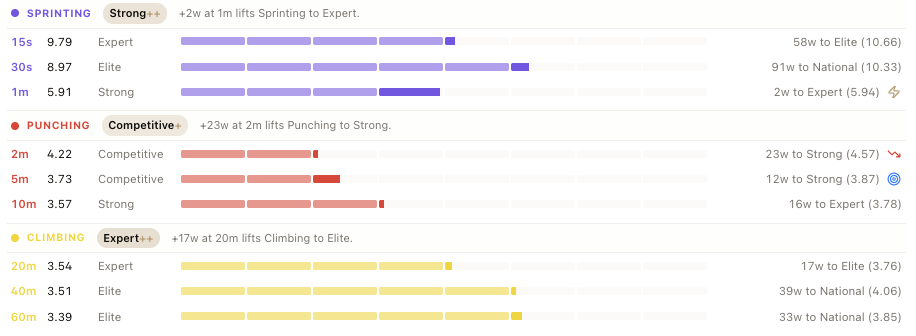
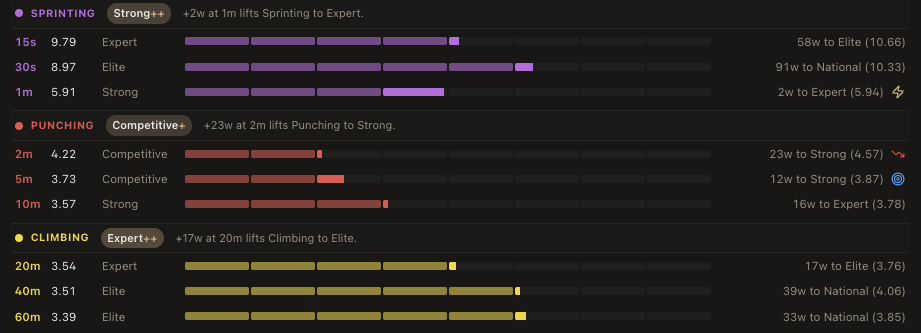
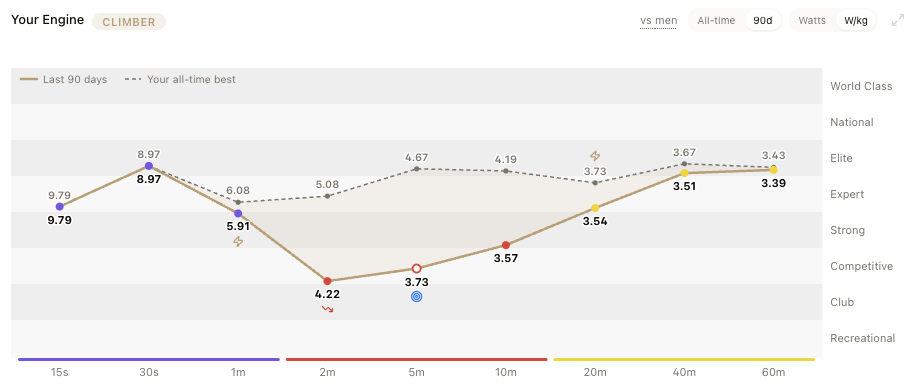
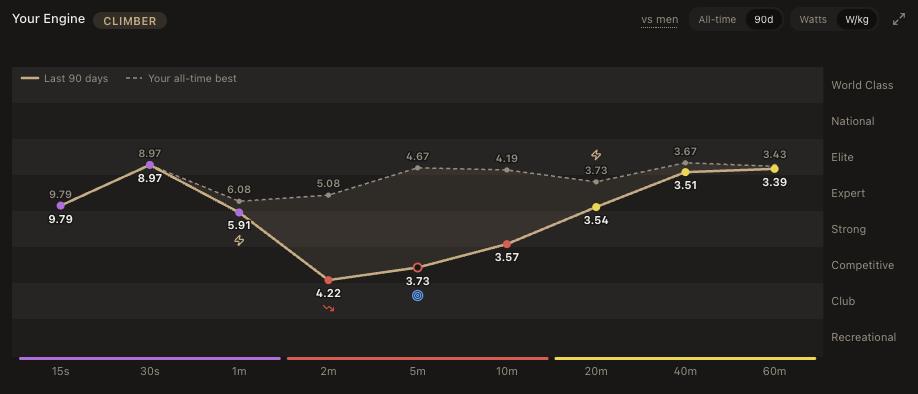
Your engine in one view. LeCoach places your best efforts from 15 seconds to 60 minutes on the ladder, grouped into sprinting, punching and climbing, and draws two lines: your all-time best and your last 90 days. The all-time line shows what your body can do, and whether you are a sprinter, a puncher, a climber or a time trialist. The 90-day line shows how much of that you are using right now. Where the two lines drift apart, an ability you have is not getting the training it needs.
Three opportunities, picked out for you. For every duration LeCoach works out the watts to the next level, and it highlights three things:
- The easiest level-up. The duration where the fewest extra watts move you up. In the example above, 2 W more at 1 minute lifts sprinting from Strong to Expert.
- The biggest gap. Where recent power has dropped furthest below your all-time best, here at 2 minutes. A short mini-block brings it back before the edge is gone.
- A value worth testing. When your best at a duration was set inside a longer effort, such as your best 5 minutes in the middle of a 10-minute climb, the number undersells you. A dedicated test shows what you can really do.
From profile to plan. LeCoach uses all of this to understand you as a rider, then builds plans and workouts around your physiology, not around an average cyclist. It suggests regular tests when a number is out of date or undersold, and short mini-blocks when an area is falling behind, always with the reason, and always your call.
When W/kg matters and when it does not
W/kg is the number that decides climbing speed. On a climb of 6 % or more, two riders with the same W/kg ride at almost the same speed, whatever their size. On the flat it matters far less. Air resistance dominates, and air resistance depends on your frontal area, not your weight. A heavier rider with more absolute watts will usually be faster on flat roads, in time trials and in breakaways.
Use W/kg as your main number if your events are hilly: gran fondos with long climbs, mountain stages, hill climbs. Use absolute watts and aerodynamics if your events are flat: time trials, criteriums, flat road races. Our guide to power-to-weight ratio for cyclists goes deeper, and the cycling speed calculator shows exactly how much weight and watts change your speed on any gradient.
Improving your W/kg: power first
There are two ways to raise W/kg: more watts or fewer kilos. For almost every rider, power is the better lever.
- Power gains are repeatable. A structured block can add 5 to 10 % to FTP for a rider who has not trained with structure before. That gain lasts as long as you keep training.
- Weight loss has a floor. Below a healthy body fat level, losing more weight costs power, recovery and health. The ideal cycling weight calculator shows where that floor sits for you.
- Losing weight while training hard is risky. Under-fuelling the sessions that build power is the fastest way to stall. If you do want to lose weight, do it slowly in your base phase, never in the weeks before a goal event.
Common mistakes
- Using a morning weight from one day. Body weight swings 1 to 2 kg with hydration. Use a weekly average.
- Comparing indoor power with outdoor benchmarks. Many riders produce less power on the trainer. Compare like with like.
- Comparing a 20-minute number with an FTP chart. Use the matching duration. The calculator does this for you.
- Chasing a W/kg target set by pros. Pro numbers come from years of training, selection and genetics. Your own trend over a season is the comparison that matters.
Sources
- Intervals.icu power-profile percentiles.
- Allen H, Coggan A, McGregor S. Training and Racing with a Power Meter, 3rd edition. VeloPress, 2019.
- Martin JC et al. Validation of a mathematical model for road cycling power. Journal of Applied Biomechanics, 1998.
Frequently asked questions
What is a good watts per kg for cycling?
Among trained cyclists who ride with a power meter, the middle of the field for FTP is about 3.3 to 3.4 W/kg for men and about 3.1 W/kg for women. Above 4.45 W/kg (men) or 4.10 W/kg (women) puts you in the top 10 %. For most recreational riders, 2.5 to 3.0 W/kg is a solid level.
How do I calculate my power-to-weight ratio?
Divide your power in watts by your body weight in kilograms. 250 W at 75 kg is 3.33 W/kg. If you know your weight in pounds, divide by 2.2046 first. The calculator above does both and works for 30-second, 1-minute, 5-minute, 20-minute, 40-minute and FTP power.
What W/kg do professional cyclists have?
Professional road riders typically hold about 5.5 to 6.5 W/kg at threshold, and the best climbers reach 6 W/kg or more for 20 to 40 minutes on decisive climbs. Tadej Pogačar goes well beyond that, but then again, he is Pogačar.
Should I use my weight with or without the bike?
Use body weight only for W/kg. That is how every benchmark is calculated. Bike and kit weight do matter for actual climbing speed, which is why the cycling speed calculator asks for both.
Is it better to lose weight or gain power?
Gain power first. Power gains are sustainable and do not compromise health or recovery. Losing weight only makes sense if you are clearly above a healthy performance body fat level, and then slowly and outside your key race period.
Does W/kg matter on flat roads?
Very little. On the flat, air resistance is the main force and it depends on your size and position, not your weight. A heavier rider with more absolute power is usually faster on the flat even with a lower W/kg.
See your whole power profile, not one number
Ask LeCoach where your power holds you back, and get a training plan built around your own rides instead of an average cyclist.
Try LeCoach for freeIn this topic
Related calculators
Estimate FTP from a 20-minute, 2 × 8-minute, ramp or 60-minute test and get your 7 power zones in watts.
Open calculator →A healthy race weight range from your body composition, and what it does to your W/kg.
Open calculator →How fast you ride at a given power, or the watts you need for a target speed, on any gradient.
Open calculator →Estimate VO2max from a 5-minute power test or your heart rate, and see how it compares for your age.
Open calculator →