AI Cycling Coach · Pillar Guide
What Is an AI Cycling Coach?
An AI cycling coach analyzes your training data — power, heart rate, recovery, and schedule — and builds structured-adaptive training plans that evolve with every ride through proposals you review. This guide explains how it works, what data it uses, and who benefits most from intelligent coaching.
Try AI Coaching Free for 14 DaysDefining the AI Cycling Coach
Most cyclists fall into one of two camps: following a static training plan downloaded from the internet, or riding without any structure at all. Both approaches leave performance on the table. A static plan can't account for the day you slept badly, the week you traveled for work, or the race that got added to your calendar last minute. Unstructured riding lacks the progressive overload needed to drive adaptation.
An AI cycling coach solves this by sitting between the two extremes. It applies the same periodization principles a human coach uses — base building, threshold development, tapering — and keeps that structured backbone visible. When you complete a ride, the AI ingests your power file, compares it to the prescription, updates your fitness model, and surfaces proposed adjustments to upcoming sessions for you to approve. This is the structured-adaptive approach. For a deeper look at the full category, see our complete guide to AI cycling coaching.
The result is a training plan that behaves less like a spreadsheet and more like a conversation — one that responds to how your body is actually performing, not how a template assumed you would.
What Data Does an AI Coach Use?
The quality of AI coaching depends entirely on the quality of inputs. Here are the data streams that power intelligent training decisions.
Power & Heart Rate
Every ride provides wattage, heart rate zones, cadence, and duration — the raw materials for load calculation.
Wellness & Recovery
HRV, sleep quality, fatigue, soreness, and mood paint a picture of readiness before each training day.
Training Load Metrics
CTL (fitness), ATL (fatigue), and TSB (form) track long-term progression and short-term recovery status.
Schedule & Constraints
Available training hours, work commitments, and goal events shape when and how hard you should train.
Goals & Events
Target events, priority races, and performance goals determine periodization structure and peak timing.
Historical Patterns
Past training responses, injury history, and progression rates inform how aggressively the AI pushes adaptation.
Not every cyclist has every data stream — and that's fine. An AI coach can start with just power and heart rate data, then become more precise as you add wellness tracking, HRV monitoring, and schedule information. The system improves with every ride, building a progressively richer model of how your body responds to training stress.
How Training Plans Adapt Over Time
Adaptation is the core differentiator between an AI coach and a static plan. A traditional plan assumes you'll hit every session perfectly, recover on schedule, and never have life interfere. Reality is messier.
When you miss a key interval session mid-week, an AI coach doesn't just skip it — it evaluates whether the session can be rescheduled, whether the training stimulus can be redistributed across remaining days, or whether the week's focus should shift, and surfaces those options for you. If your HRV drops and fatigue rises, the coach will flag it and propose swapping tomorrow's threshold workout for a recovery spin — but you stay in the loop and decide.
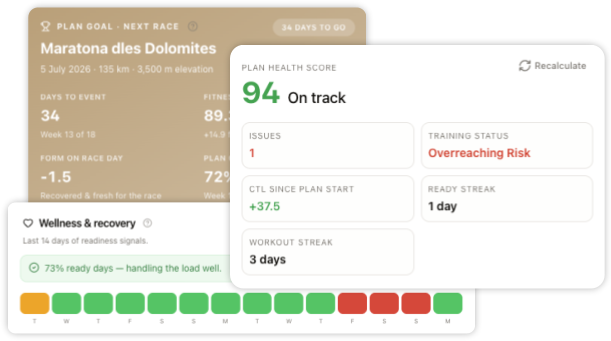
Consider a practical example: you're preparing for a gran fondo in 12 weeks, but your work schedule gives you only 6 hours in some weeks and 10 in others. A static plan written for 8 hours per week will either underload or overload you constantly. An AI coach accounts for your actual availability each week, packing key sessions into the hours you have and protecting recovery when time is short.
Over months, this compounding precision makes a measurable difference. Every session is purposeful, every recovery day is earned, and your progression curve stays smooth instead of jagged.
AI Coaching vs Static Training Plans
Static training plans are useful as a starting framework, but they break down the moment reality deviates from assumptions. They can't detect that you're carrying residual fatigue from last week, that your FTP has risen and your zones need updating, or that a schedule change means you should front-load your training volume.
Static Plan
- • Written once, never changes
- • Assumes perfect adherence
- • Fixed intensity regardless of fatigue
- • No response to missed sessions
- • Zone updates require manual recalculation
- • Same plan for every rider at your "level"
AI Coach
- • Reviews every ride and surfaces proposed changes
- • Adapts to actual performance — with your approval
- • Flags low readiness and proposes scaled sessions
- • Proposes redistribution when training is missed
- • Suggests zone updates from data, you confirm
- • Personalized to your physiology and your call
The gap widens over time. In week one, both approaches might produce similar sessions. By week eight, the static plan is likely prescribing workouts that are either too easy (if you've adapted faster than expected) or too hard (if life got in the way). The AI coach has been adjusting continuously, keeping you in the productive training zone throughout.
How AI Compares with Human Coaching
The question isn't whether AI coaching is "better" than human coaching — it's where each excels. An AI coach processes data faster, never forgets a detail, and is available at 2 AM when you're wondering whether to ride hard tomorrow after a restless night. A human coach brings emotional intelligence, race experience, and the ability to read between the lines of what you're telling them.
For most self-coached cyclists, an AI coach delivers the structured, data-driven training guidance they need at a fraction of the cost. For competitive athletes who need tactical race planning or athletes working through injury, a human coach remains valuable. Many riders find the ideal setup is both — an AI handling day-to-day plan management with a human coach providing strategic oversight. We explore this tradeoff in detail in our guide to AI cycling coach vs human coach.
Who Is an AI Coach Best Suited For?
AI coaching works best for cyclists who train consistently and want intelligent structure without the cost of a human coach. Specifically:
Self-Coached Riders
You know the basics but want data-driven decisions about intensity, volume, and recovery timing.
Time-Crunched Athletes
Limited training hours mean every session must count. AI ensures you're doing the right workout on the right day.
Goal-Oriented Cyclists
Training for a specific event like a gran fondo, sportive, or time trial with a deadline and a target performance.
Riders Returning After a Break
Coming back from injury, illness, or time off requires careful load management that AI handles precisely.
If you're evaluating options, our guide to finding the best AI cycling coach covers what features matter most and how to compare platforms effectively.
Real-World Examples
Understanding AI coaching is easier through concrete scenarios:
Missed Workouts
You planned a VO2max session on Wednesday but got stuck at work. A static plan just moves on — that stimulus is lost. An AI coach evaluates your remaining week: can Thursday absorb a harder session? Should Friday's endurance ride incorporate some intensity? Or is it better to accept the miss and protect the weekend's long ride? The AI makes this call based on your fatigue state and remaining availability.
Variable Schedule
You're a parent with unpredictable childcare. Some weeks you get 8 hours, others only 4. An AI coach doesn't just scale workouts down — it prioritizes differently. In a 4-hour week, it protects your one key interval session and one endurance ride, dropping supplementary sessions. In an 8-hour week, it adds volume strategically without suddenly overloading you.
Gran Fondo on Limited Time
You've registered for a 150km gran fondo in 10 weeks but can only train 6 hours per week. An AI coach builds a targeted plan that prioritizes sustained power development and fueling practice, structures your longest ride to progressively extend without exceeding recovery capacity, and times a proper taper so you arrive fresh on race day.
Experience AI Coaching with LeCoach
LeCoach brings everything described on this page into a single platform — adaptive training plans, wellness-aware adjustments, and conversational AI cycling coaching that evolves with every ride. Connect your power meter, set your goals, and let the AI build your training from day one.
Start Free TrialFrequently Asked Questions
In This Topic
Supporting articles related to this pillar will appear here as they are published.
Related Pillars
- Best AI Cycling Coach
Compare features, pricing, and capabilities across AI coaching platforms.
- AI Cycling Coach vs Human Coach
Understand where AI excels, where humans win, and when to use both.
- About LeCoach
The founder story and the principles behind the coach.
This page is part of the AI Cycling Coach topic cluster on LeCoach.