What tempo is, and why people love it or hate it
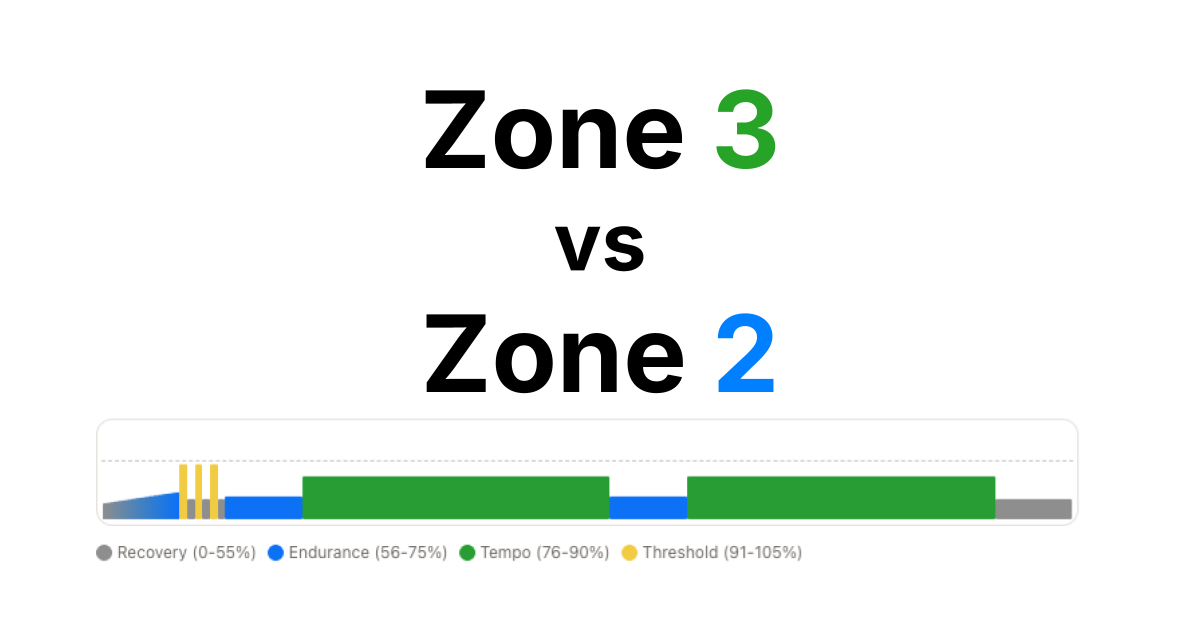
Tempo sits between easy endurance and hard threshold. On a typical FTP-based model it’s roughly 75–90% of FTP, but the number matters less than the sensation: you’re working, you need to focus, you can still talk, but only in short phrases. It feels strong without feeling desperate.
That’s exactly why people love it. It’s a satisfying intensity to sit on. You can “get something done” in an hour without needing a long warm-up runway or a big nap afterwards.
It’s also why people hate it. Tempo is close enough to harder work that a small pacing error changes the whole session. Push just a touch too high, and what should have been a repeatable aerobic stimulus becomes a grinding threshold effort. Not an obvious blow-up. More like a slow leak: heart rate creeps, breathing gets louder, and by the end you’ve spent more matches than you planned.
If you’ve ever finished a tempo ride thinking, “that felt harder than it should have,” you’ve found the knife-edge.
Why the heavy domain can be a sweet spot when time is limited
A useful way to understand tempo is through intensity domains rather than zone charts. Much of what cyclists call tempo sits in the heavy domain: above the first metabolic threshold (often described as LT1/VT1) and below the second (LT2/VT2). It’s still aerobic, but it’s a more demanding aerobic gear than zone 2.
This is where tempo shines for time-crunched riders.
Zone 2 builds a deep base, but it’s a low-risk, lower-stimulus gear per hour.
Threshold and VO₂max can be potent, but they’re also costly, and you can’t stack them carelessly without paying for it.
Heavy-domain work is often the middle road that actually works: hard enough to force adaptation, controllable enough that you can recover and repeat.
There’s another practical advantage: short, punchy interval formats are great for specific qualities, but they don’t always allow much clean, continuous “time in zone.” Tempo does. You can bank meaningful minutes of steady pressure, week after week, without every session feeling like a test.
On the lower end of tempo, well-fueled riders can sustain it for a long time. Not forever, but long enough that it becomes extremely relevant for long climbs, headwinds, steady gravel pacing, and those moments in racing where the action settles and you still need to keep pressing.
How strong riders use tempo in blocks (and how to copy it)
You’ve probably heard some version of “avoid the grey zone” or “do 80/20.” The problem is that people treat these ideas as rules for every week of the year.
In the real world, strong riders don’t train as a single, flat average. They train in phases. Over a long season, the distribution may skew heavily toward easy riding, but in specific blocks—especially camp-style weeks with lots of climbing—tempo shows up constantly. It’s not because they forgot what polarized means. It’s because the terrain and the goal of the block demand steady pressure, repeated day after day, without turning every climb into a maximal effort.
That’s the part amateurs can copy: use tempo in chunks.
A simple tempo block for a time-crunched rider might look like two to three weeks where you deliberately build time in tempo (without drifting into threshold), then a lighter week, then a shift toward either more volume, more high intensity, or more event-specific work depending on your goal.
If you want a plan that adjusts those blocks to your available time, recovery signals, and what you actually completed (instead of what you hoped to complete), that’s exactly what LeCoach is built for.
The knife-edge: keeping tempo as tempo
Tempo is simple on paper, but it’s easy to do it wrong in practice. Here’s how I keep athletes honest.
Use power to start, and heart rate to keep it honest
Power gets you into the right ballpark. Heart rate tells you when the session is slipping into a different intensity domain.
If you hold a steady tempo power for a long stretch, heart rate often drifts upward over time, especially indoors or in warm conditions. Dehydration and under-fueling accelerate the drift. The mistake is interpreting that drift as “I should push through.” Often it’s a sign you’re no longer doing the session you intended.
A practical rule that works well:
Pick your tempo power range for the day.
Set a heart-rate ceiling.
Allow a small rise (often around 5–10 bpm depending on the rider and conditions).
When you hit the ceiling, reduce power slightly or stop the interval.
That keeps tempo repeatable, which is the whole point.
Fuel it like training, not like a casual ride
Tempo is one of the first intensities where fueling mistakes become obvious. Under-fuel it and you’ll see the pattern: heart rate climbs for the same power, cadence starts to fall, and the last third of the session becomes survival.
A conservative starting point for many riders is 30–60 g of carbohydrate per hour, adjusting upward with duration, intensity, and tolerance. If you’re doing long tempo blocks inside a long ride, most athletes do better closer to the upper end.
Add cadence variation if monotony makes you push too hard
Tempo can feel monotonous, and monotony often leads to pacing errors. One way to keep it controlled without changing the session goal is small cadence variation, for example steady tempo with brief spin-ups. You still accumulate time in tempo, but you stay engaged and you avoid the “tempo creep” that turns the session into threshold.
Three sessions and a simple three-week block
Below are options that map closely to how tempo gets used in the real world: steady pressure, lots of time in zone, and repeatability.
Session 1: the repeatable classic
3 × 20 minutes at tempo, 5 minutes easy between.
Progress it by adding time before you add intensity: 3×25 → 2×35 → 1×60. If the work starts to feel like threshold, you’re progressing the wrong thing.
Session 2: the steady grinder
45–75 minutes continuous at low-to-mid tempo.
This is the session that teaches pacing discipline. It also tells you the truth about your fueling and cooling setup, especially indoors.
Session 3: tempo inside a longer ride
During a 2.5–4 hour ride, do 3–5 × 12 minutes at tempo, spaced out.
This is where tempo becomes durability training. You practice finding that strong, sustainable pressure after you’re already a bit tired.
A simple three-week block (time-crunched version)
Week 1: 1–2 tempo sessions + easy volume
Week 2: 2 tempo sessions (slightly more total time in tempo) + easy volume
Week 3: keep intensity the same, add a little more time in tempo, then deload after
If week 2 already feels heavy, don’t force week 3. Tempo only works when it stays repeatable.
Common mistakes and who should be cautious
Tempo is not a universal answer.
Be cautious if:
you’re sprint-leaning and you’re cutting out all top-end work for weeks (many riders feel flat)
you’re doing tempo “most days” because it feels productive (that’s how you get stale)
your “tempo” regularly finishes with heart rate deep into threshold territory
The fix is usually not dramatic. It’s boring coaching: slightly lower the target, cap heart rate, fuel better, and keep tempo in a phase rather than as your default intensity.
The real rule isn’t “avoid the grey zone.” The rule is: don’t live there by accident.
Sources
Nuuttila OP, et al. (2025). the accuracy of fixed intensity anchors to estimate lactate thresholds and intensity domains (open access). https://pmc.ncbi.nlm.nih.gov/articles/PMC12354492/
Souissi A, et al. (2021). a new perspective on cardiovascular drift during prolonged exercise. https://pubmed.ncbi.nlm.nih.gov/34717912/
Laginestra FG, et al. (2023). stroke volume response during prolonged exercise depends on intensity (and relates to cardiovascular drift). https://journals.physiology.org/doi/full/10.1152/ajpregu.00293.2022
Rosenblat MA, et al. (2019). polarized vs threshold training intensity distribution on endurance sport performance: systematic review and meta-analysis. https://pubmed.ncbi.nlm.nih.gov/29863593/
Oliveira PS, et al. (2024). effects of polarized training vs other training intensity distributions: systematic review with meta-analysis. https://link.springer.com/article/10.1007/s40279-024-02034-z